Nixon's Shadow by David Greenberg
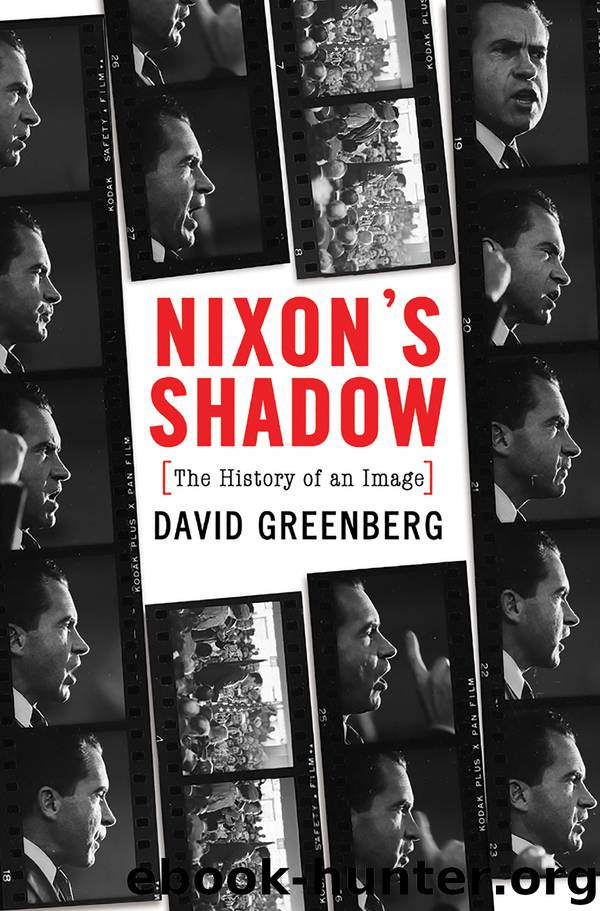
Author:David Greenberg
Language: eng
Format: epub
Publisher: W. W. Norton & Company
Published: 2017-07-22T04:00:00+00:00
* The interview was initiated by administration staffer Bill Baroody and launched by Nixon aide Bruce Herschensohn. Frank Gannon of the press office helped write Korff’s questions, and Nixon’s old friend Ralph de Toledano worked on the final text.
† See chapter 7 for a fuller discussion.
‡ The other states were Delaware, Michigan, Minnesota, Missouri, New Jersey, New Mexico, Nevada, Pennsylvania, and South Carolina. Kennedy’s people countered and asked for a recount in Hawaii. None of the Kennedy states ended up being awarded to Nixon; but, ironically, Hawaii’s recount did lead to that state’s falling into Kennedy’s column. Hawaii’s vote was not settled until December 28, 1960, after the Electoral College convened but before Congress met to certify the Electoral College results.
§ The role of House Minority Leader Gerald Ford came under scrutiny during his 1973 hearings to be confirmed as vice president. Nixon had told aides to have Ford enlist GOP congressmen in thwarting Patman. “He’s [Ford’s] got to know that it [the order] comes from the top,” Nixon said, “and he’s got to get at this and screw this thing up.” Although Ford apparently didn’t take his marching orders directly from the White House, he and other Republicans hardly needed prodding. “Because of the political overtones of this matter,” Ford wrote to one GOP committee member, “I think it would be imperative for all Republican members to be present at the Committee meeting to assure that the investigative resolution is appropriately drawn.” When questioned, Ford denied any collusion with the White House, and in 1976 the Watergate Special Prosecutor, Charles Ruff, rebuffed Democratic requests to pursue obstruction-of-justice charges against Ford.
¶ The magazine’s Washington correspondent, George F. Will, dissented, insisting that the press’s “prolonged scrutiny of Watergate” stemmed from a sense of professional duty. This independence from conservative orthodoxy helped Will to become a columnist for Newsweek and brought him national fame.
# In fact, the FBI monitored the conversations of Anna Chennault, a Nixon loyalist with ties to the South Vietnamese. Chennault was urging Saigon—treasonously, Johnson felt, and possibly at Nixon’s bidding—to reject his peace proposals so as to secure a better deal after Nixon took office.
** This is the conversation whose secret recording was marred by the mysterious (but deliberate) erasure of a crucial 18½ minutes. The “Anderson Files” probably refers to columnist Jack Anderson’s publication in December 1971 of classified information about Nixon’s policy toward the feuding nations of India and Pakistan.
†† Phillips insisted his change of heart “had nothing to do with Watergate,” which he called “a means that was used by the left to derail significant policy changes.”
‡‡ As time passed and passions cooled, Haldeman and others backpedaled. After the publication of The Ends of Power and his release from prison, Haldeman reconciled with Nixon and repudiated some of the criticisms of Nixon in his memoir as the work of his co-author, Joseph DiMona. DiMona insisted that the book accurately reflected Haldeman’s views at the time.
§§ See chapter 8.
¶¶ The most surprising enthusiast of the CIA theory was Senator Howard Baker.
Download
This site does not store any files on its server. We only index and link to content provided by other sites. Please contact the content providers to delete copyright contents if any and email us, we'll remove relevant links or contents immediately.
Fanny Burney by Claire Harman(26574)
Empire of the Sikhs by Patwant Singh(23047)
Out of India by Michael Foss(16832)
Leonardo da Vinci by Walter Isaacson(13262)
Small Great Things by Jodi Picoult(7093)
The Six Wives Of Henry VIII (WOMEN IN HISTORY) by Fraser Antonia(5471)
The Wind in My Hair by Masih Alinejad(5063)
A Higher Loyalty: Truth, Lies, and Leadership by James Comey(4927)
The Crown by Robert Lacey(4777)
The Lonely City by Olivia Laing(4777)
Millionaire: The Philanderer, Gambler, and Duelist Who Invented Modern Finance by Janet Gleeson(4433)
The Iron Duke by The Iron Duke(4331)
Papillon (English) by Henri Charrière(4232)
Sticky Fingers by Joe Hagan(4158)
Joan of Arc by Mary Gordon(4069)
Alive: The Story of the Andes Survivors by Piers Paul Read(4003)
Stalin by Stephen Kotkin(3928)
Aleister Crowley: The Biography by Tobias Churton(3613)
Ants Among Elephants by Sujatha Gidla(3446)
